
Hancock County Clerk Records
Georgia does not use a District Clerk title for Hancock County. The principal court-record officer is the Hancock County Clerk of Superior Court. The county Superior Court page says the clerk supports both Superior and Juvenile Courts and maintains real estate, civil, criminal, and other official records. That makes the office the core local point for Superior Court records, divorce copies, certified case documents, and related filing questions.
The GSCCCA clerk profile names LeShauna R. Jackson as Hancock County Clerk of Superior Court and states that the office manages Superior and Juvenile Courts. It also lists Rhoda Taylor as chief deputy and identifies the legal organ as the Sparta Ishmaelite. GSCCCA lists services that include habeas, passport agents, and child support court-cost payment only.
GSCCCA publishes the Hancock County clerk profile with the official clerk listing and office services.
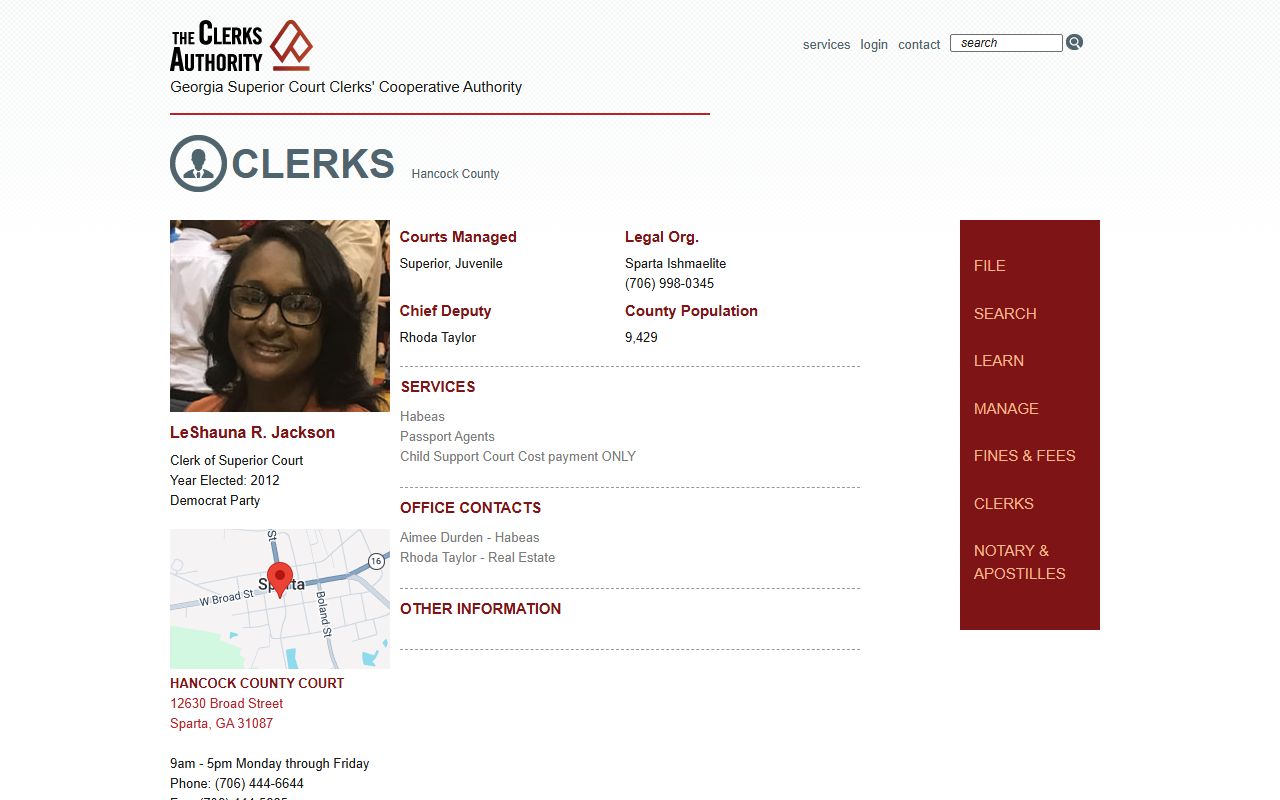
The GSCCCA profile is useful when confirming the clerk title, court coverage, phone number, fax number, and listed services.
Hancock County Clerk of Superior Court
Clerk: LeShauna R. Jackson
12630 Broad Street
Sparta, GA 31087
(706) 444-6644
Clerk Jackson: ext. 2009, Leshauna.jackson@gsccca.org
Chief Deputy Rhoda Taylor: ext. 2010, Rhoda.taylor@gsccca.org
Monday-Friday, 9:00 a.m.-5:00 p.m.
Fax: (706) 444-5685
Hancock County Clerk Duties
The Clerk of Superior Court is not the probate clerk and not the Sheriff. For Hancock County court records, the clerk's work centers on Superior Court and Juvenile Court filings, while Probate Court handles estates, wills, marriage licenses, traffic matters, vital records, and involuntary commitments. The county's court directory also separates Magistrate Court matters such as small claims, garnishments, bad checks, landlord and tenant claims, bonds, mediation, and pretrial services.
That split matters when a person asks for records. A divorce decree should be requested from the Clerk of Superior Court because Georgia.gov says divorce copies are held by the clerk in the county where the divorce was granted. An estate file should go to Hancock County Probate Court. A jail booking question should go to the Sheriff. A small-claims or landlord filing should start with Magistrate Court.
- Maintain Superior Court civil, criminal, real estate, and other official records.
- Support Superior Court and Juvenile Court filing functions in Hancock County.
- Handle certified-copy questions for Superior Court documents.
- Route electronic filing through PeachCourt where supported.
- Connect users to FANS for name-based filing notifications.
Hancock County Certified Copies
Certified copies are used when a plain printout is not enough. They may be needed for divorce proof, court orders, judgment records, name changes, or other legal and administrative uses. Hancock County Superior Court says certified court documents may be requested and delivered electronically through GSCCCA eCertify, while direct office contact remains the fallback for records not available through the order flow.
Before ordering, identify the court, case type, party names, document name, and approximate filing date. If a case number is known, include it. If the request involves a sealed, juvenile, adoption-related, or restricted record, ask the clerk what authority is required. Georgia law can limit access to some files even when a related docket entry exists.
- Confirm that the requested document belongs to Hancock County Superior Court or Juvenile Court, not Probate, Magistrate, Sheriff, or another agency.
- Search any known e-file or case information first, then gather party names, case number, document title, and date range.
- Use eCertify for eligible electronic certified documents, or call the Clerk of Superior Court for office-copy instructions.
- Ask for the current fee, payment method, turnaround time, and whether pickup, mail, fax, or electronic delivery is available.
- Verify that the copy is certified if the receiving agency requires a seal or certification statement.
GSCCCA eCertify is the electronic certified-document route named by Hancock Superior Court.
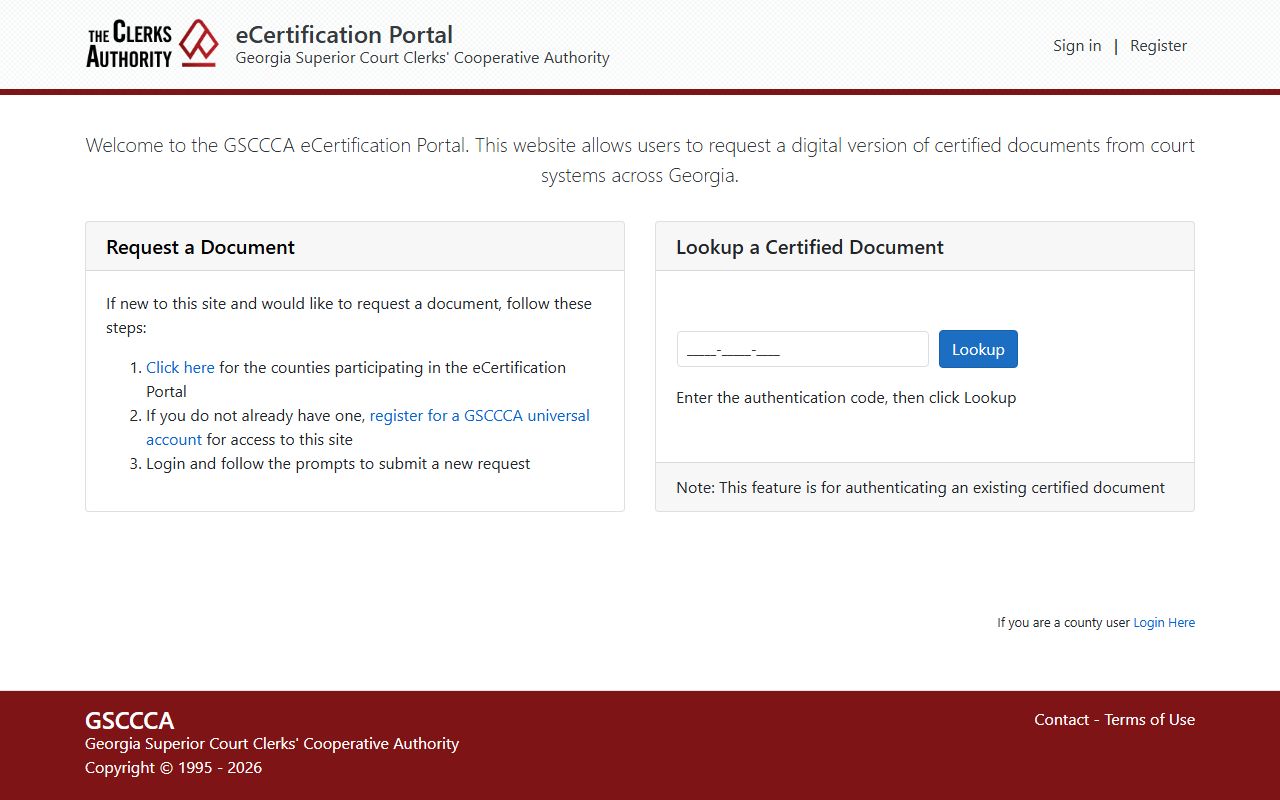
eCertify can be faster than waiting for an in-office certified-copy process when the requested court document is eligible.
Hancock County Clerk Request Fields
No Hancock-specific mail-order certified-copy form was located in the official sources reviewed. A useful clerk request still follows a simple pattern. Provide enough detail for staff to find the file, confirm whether it is public, and price the copy. For electronic systems, some fields depend on the provider and account status rather than a public county screen.
| Field | Required | Notes |
|---|---|---|
| Case number | Helpful when known | Georgia eFileGA notice uses a four-digit year, dash, CV or CR, and leading zero format clue. |
| Party names | Yes | Use full names and alternate spellings if known. |
| Document type | Yes | Examples include divorce decree, order, judgment, pleading, sentence, or docket entry. |
| Copy type | Yes | State whether a plain copy or certified copy is needed. |
| Date range | Helpful | Include filing year, hearing date, judgment date, or approximate case period. |
| Delivery method | Ask office | Confirm in-person, mail, electronic, or other delivery options before paying. |
Hancock County Clerk Online Access
Hancock County does not publish a county-built public case-search portal in the official sources reviewed. The practical online map is a set of Georgia systems that serve different needs. PeachCourt supports civil and criminal electronic filing. eCertify supports electronic certified documents. FANS provides name-based filing notifications. Georgia Courts e-access points users to provider sites and states that account access is required.
PeachCourt is named by Hancock Superior Court for civil and criminal e-filing by attorneys and self-represented litigants.

PeachCourt should be treated as a filing and document platform, not as a promised free anonymous Hancock County case lookup.
FANS provides real-time email notifications when filings are recorded in a person's name in participating Georgia counties.
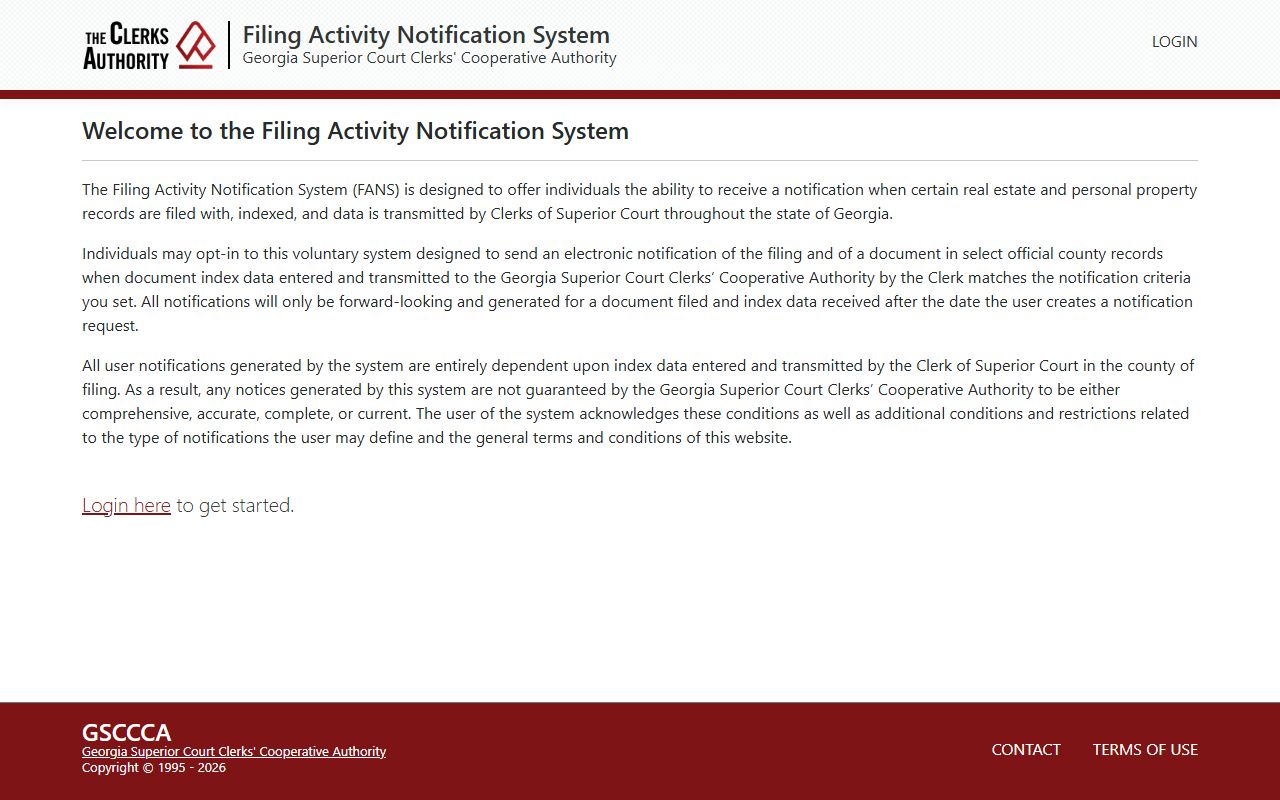
FANS is best described as a filing-notice system, not a full court-record database.
Hancock County Clerk Search Fields
The located public systems do not all expose the same fields. Some require registration, an account, or an order workflow. The table below reflects the field and access notes captured from official research sources and should be used with the limits stated by those systems.
| Field Label | Type | Required | Options or format notes |
|---|---|---|---|
| PeachCourt Register | Account workflow | Required for e-filing | Public page shows registration; exact fields were not visible in captured text. |
| PeachCourt Forgot your password | Account recovery | No | Account recovery link appears on the public page. |
| eFileGA case number | Text | Unspecified | Use four-digit year, dash, CV or CR, and a 0 before case number per public notice. |
| FANS enrollment | Account or email workflow | Required for notices | For real-time email notices when filings are recorded in the enrollee's name. |
| eCertify request | Order workflow | Required for certified copy | Exact order fields sit behind the request flow. |
Georgia Courts e-access redirects users to provider websites and notes account requirements.
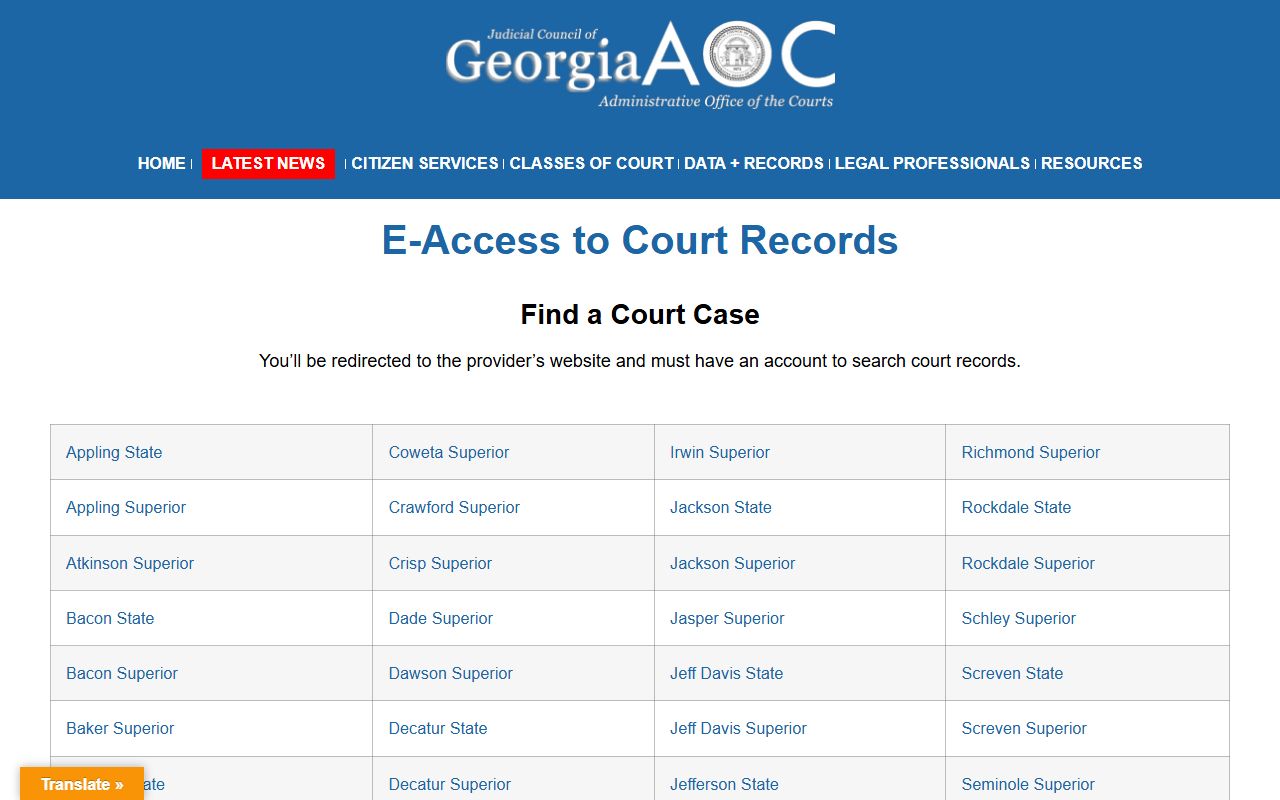
Hancock County was not confirmed as a direct public e-access county in the visible list captured during research.
eFileGA provides the case-number format notice captured in the research.
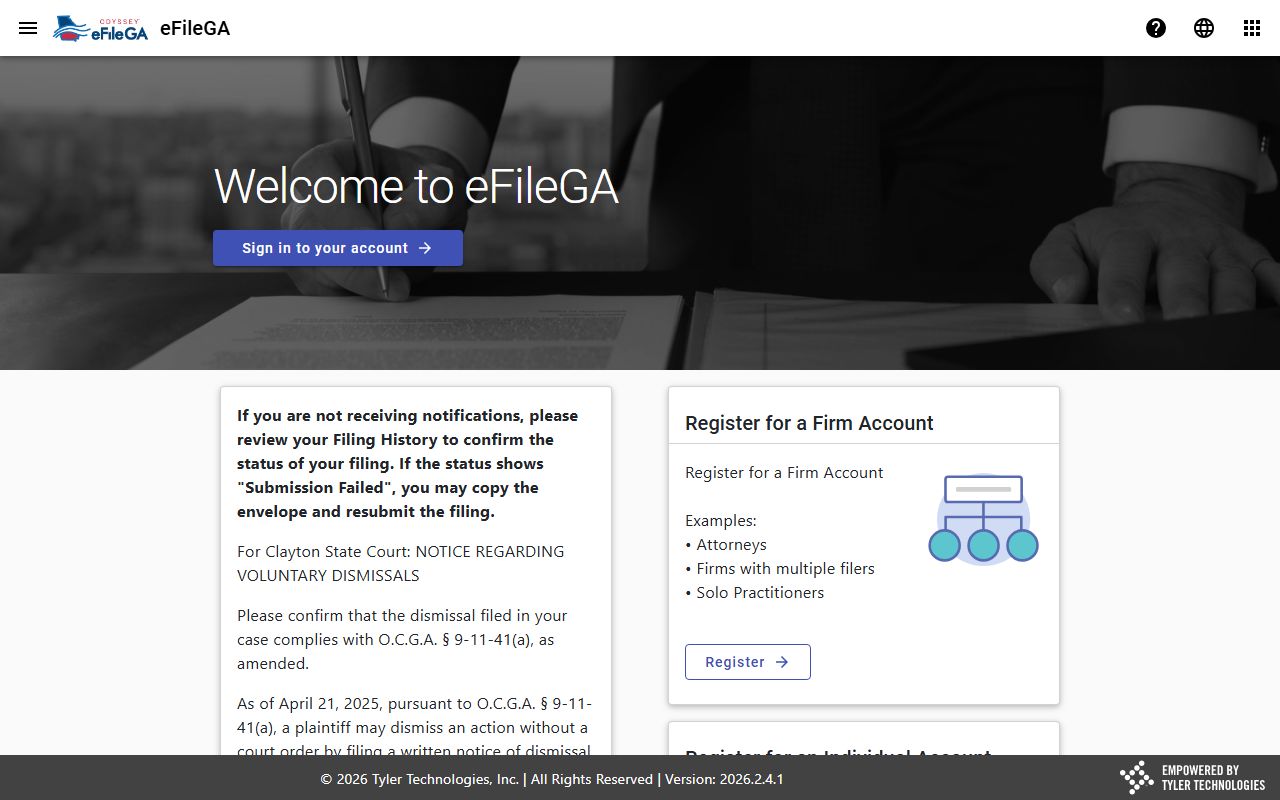
The eFileGA format clue can help prepare a search, but it does not prove every Hancock County case is publicly searchable there.
Hancock County Clerk Fees
Official Hancock County sources reviewed did not publish exact local amounts for Superior Court plain copies, certified copies, eCertify order fees, or FANS enrollment. The correct approach is to contact the clerk before ordering or filing. The GSCCCA profile does list child support court-cost payment only, but the amount depends on the case.
| Item | Amount | Source note |
|---|---|---|
| Superior Court plain copies | Not located in official Hancock sources | Contact the Clerk of Superior Court. |
| Superior Court certified copies | Not located in official Hancock sources | County page routes electronic certified documents to eCertify. |
| eCertify order fees | Not located in captured public text | Verify during the eCertify order flow. |
| FANS enrollment | Not located in captured public text | Confirm in the FANS enrollment system. |
| Child support court-cost payment | Depends on case | GSCCCA lists the service but no fixed amount. |
Restricted Hancock County Clerk Records
Some records managed through the Clerk of Superior Court are not public in full. GSCCCA identifies the Hancock clerk as managing Juvenile Court, and Georgia juvenile statutes limit inspection of juvenile court and law-enforcement records. Criminal-history record restriction is handled under Georgia law and is different from routine public copy access.
For criminal-history restriction, O.C.G.A. § 35-3-37 can allow eligible people to seek restriction and, in some cases, sealing of clerk-maintained criminal-history information through the court with original jurisdiction. The clerk can identify the local filing channel, but eligibility depends on the statute, the prosecutor's role, the case result, and the court's order.